Sales teams often inherit a problem that looks like weak closing, but is actually flawed positioning that Sales is being asked to repair live.

April 24, 2026
You keep the pipeline full. You build compelling pitches. Prospects nod at the technical explanation, but keep comparing you to firms that do a third of what you do. Every conversation turns into a price comparison. The champion who asks sharp technical questions for six weeks, then turns out to have no budget and no real authority to buy anything.
This may not be a sales execution problem. It may be a positioning problem that Sales is being asked to repair live.
In engineering-led businesses, poor positioning does not simply reduce lead volume. It can attract the wrong opportunities. It can send the company into the wrong buying conversation. It can make a strong technical team look like a replaceable vendor because buyers are using the wrong frame from the start.
Most of the decision happens before you're in the room
Gartner's research on B2B buying found that buyers spend only about 17% of the entire purchase journey meeting with potential suppliers, and that time is split across every vendor they're considering, not just you. Research from 6sense adds a sharper edge: roughly 81% of buyers already have a preferred vendor in mind by the time of first contact.
Put those two numbers together and the implication is sobering: most of the evaluation happens without you in the room. What does the work in your absence is your positioning: what kind of company the buyer believes you are, what they think your work actually changes, and which other companies they've mentally grouped you with.
That last part tends to decide the deal. The buyer's comparison set becomes the frame for everything that follows. Get filed alongside build-to-spec shops, and you'll be handed a spec and asked for a price. Get filed alongside component vendors, and a component-sized budget shows up. Your capability isn’t evaluated in a vacuum, but in a frame that was set before you arrived.
Take a machine vision company as an example. Its real economic value sits downstream: fewer quality escapes, less rework, fewer warranty claims, earlier visibility into production risk for the people who run the plant. But its website leads with optics, resolution, and inspection speed. So it gets invited into inspection-tool bake-offs, compared against camera vendors, and judged on frame rates by engineers. It's now in a conversation that is missing the quality director who actually owns the cost of an escape, because nothing in the story was ever built to reach them. The company loses on price to weaker tools, and wins only when a determined rep manages to rebuild the frame mid-deal.
Same technology, very different buying conversation, depending entirely on which one the market was told to expect.
The reframe tax

There's a reliable way to spot this inside your own team: listen to first-call recordings and count how often someone says a version of "actually, we're more like…"
Every one of those moments is unteaching. And a story that gets corrected partway through costs more than the extra time it takes. A buying committee experiences it as inconsistency: Engineering heard one version, Operations heard the corrected one, and now the group doesn't fully agree on what it's even evaluating. FOMU (Fear Of Messing Up) kicks in, and they move towards a safer option.
Gartner's 2025 buyer research found that 74% of B2B buying groups showed unhealthy conflict somewhere in the process, and that the groups who reached real internal consensus were far more likely to report a high quality deal. A position that has to be repaired mid-deal is working directly against that alignment, deal by deal.
In practical terms, the supplier’s job is not only to impress a technical champion. It is to help the buying group agree on what problem they are solving and why this kind of partner belongs in the decision.
Applying the 6DOF lens
Four of the six dimensions in the 6DOF Framework tend to explain most of this pattern. Category asks whether buyers are placing the company in the right mental bucket before the first call even happens. Value asks whether they understand the nature of the value being created, not just the feature set. Audience asks whether the message is actually reaching the people who can move the deal, rather than only the people who can evaluate the method. Narrative Balance asks whether the technical story is being told in the right proportion to the business story.
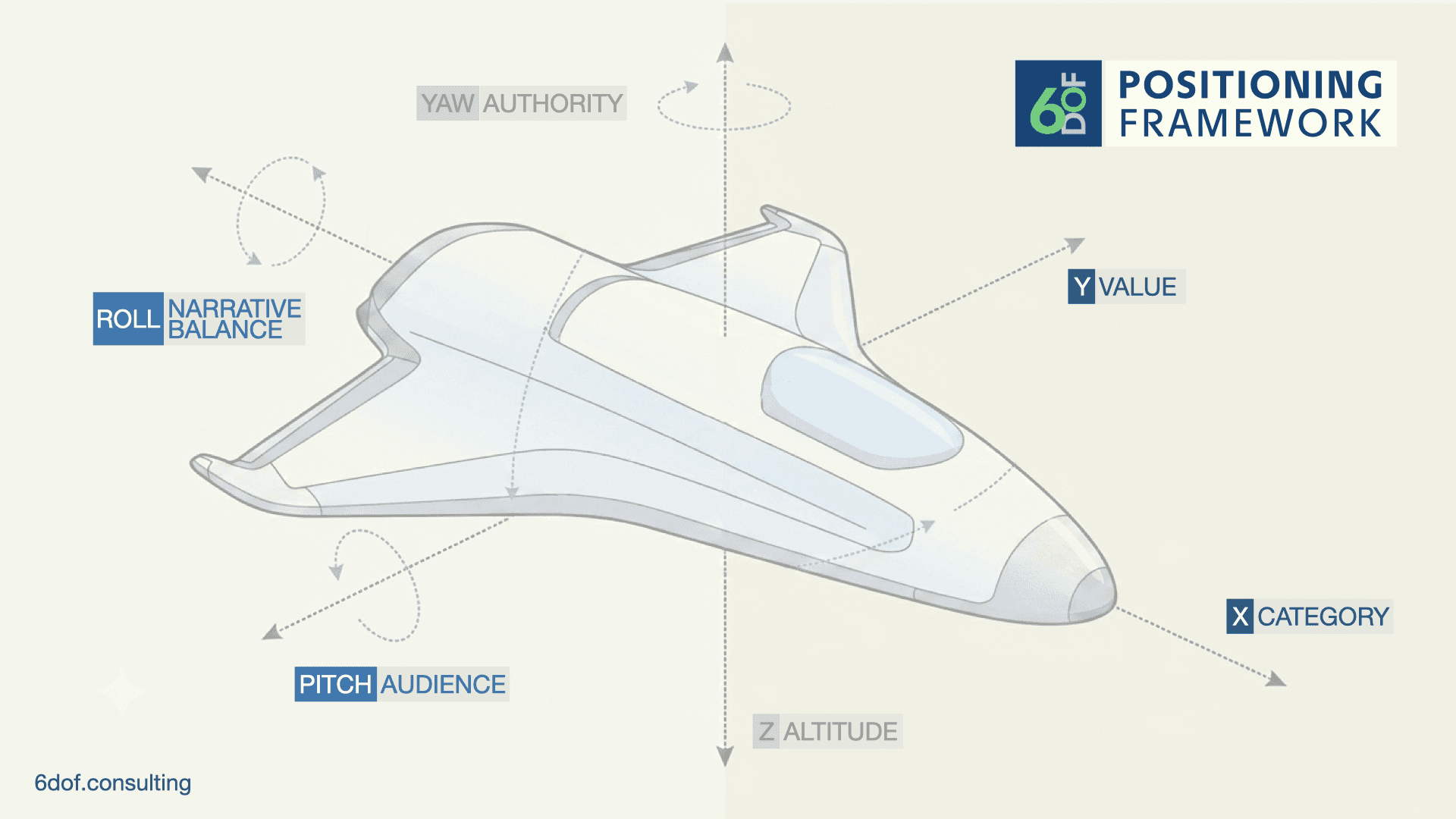
When one or more of these is off, "bad-fit deals" stop looking random. They start looking like the market repeating back exactly what it was told.
What to check this week
Pull the last ten lost-deal notes and set aside the stated loss reason. Look instead at the comparison set. Who else made the final two or three, and what does that grouping say about how the buyer categorized you from the start?
Count the reframes in first-call recordings. If some variation of "actually, we're more like…" shows up more than occasionally, your category signal is wrong. Every deal is starting with a correction instead of a clean story.
Check whether wrong-fit prospects ever disqualify themselves. If sales is doing all the filtering, your positioning is doing none of it.
One question worth carrying into your next pipeline review: who did the buyer think we were when this deal started? If the honest answer changes from deal to deal, your win rate needs a positioning correction before a sales process review.
That question is where a 6DOF diagnostic begins, working through all six dimensions to find which one is pulling the wrong deals into the pipeline. If you want it answered systematically, get in touch.